
Explore Asia with Confidence – Discover, Plan & Travel Smart with The Asia Guide

China Internet Restrictions Guide: What Tourists Should Know
China Internet Restrictions Guide for tourists: learn which websites and apps are blocked, how the Great Firewall works, whether a VPN is required, and how eSIM routing affects internet access while traveling in China.
Tuhin K. Chakma
3/2/20262 min read
# China Internet Restrictions Guide: What Tourists Should Know
Traveling to China comes with a unique digital environment.
Many international websites and apps do not function the same way they do in other countries. Before your trip, it is important to understand how internet restrictions in China work and how they affect tourists.
This guide explains what is restricted, what works normally, and how travelers can prepare.
---
## Why Does China Restrict Certain Websites?
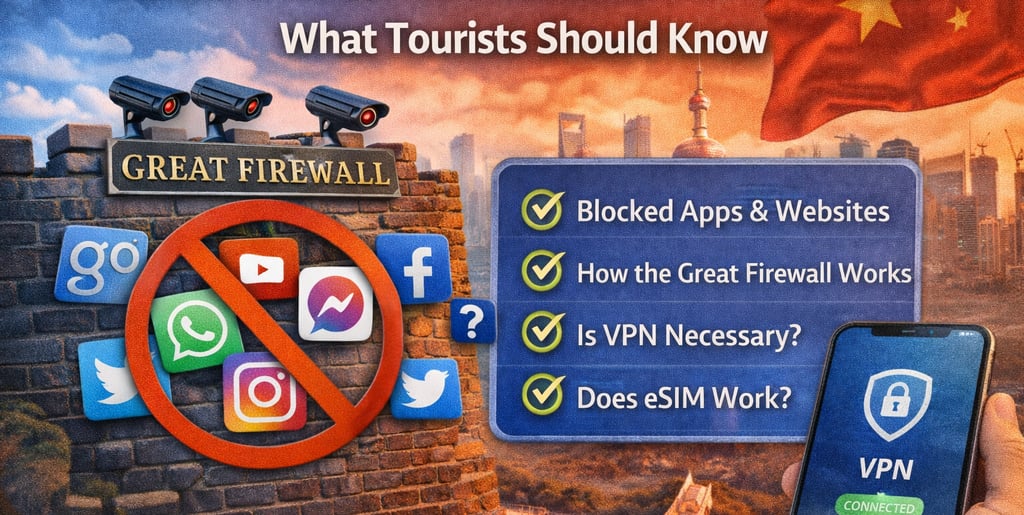
China operates a national internet filtering system often referred to as the “Great Firewall.”
The system regulates access to certain foreign platforms and services.
The purpose is to control digital traffic within mainland China.
For tourists, this mainly affects international apps and websites.
---
## Which Websites and Apps Are Restricted in China?
Commonly restricted services include:
- Google Search
- Gmail
- YouTube
- Twitter (X)
These services may not load when using a local mainland network.
---
## What Apps Work Normally in China?
Many apps function without restriction, including:
- Chinese local apps
- Alipay
- Chinese maps
- Domestic streaming platforms
Travelers relying on local services will not face major issues.
---
## Does eSIM Bypass Internet Restrictions?
It depends on routing.
If an international roaming eSIM routes traffic through Hong Kong or another international gateway:
- Some blocked apps may work
- VPN may not be required
If the eSIM connects directly to mainland Chinese networks:
- Restrictions apply
- VPN is required
Routing matters more than SIM type.
---
## Do Local Chinese SIM Cards Require VPN?
Yes.
Local physical SIM cards connect directly to mainland networks.
Access to restricted international apps requires VPN configuration.
---
## Is VPN Legal in China?
VPN regulations in China are complex.
Some VPN services operate with varying reliability.
Tourists should install and test VPN services before arrival, as app store access may be limited once inside China.
---
## Can Airport WiFi Access Block Apps?
Airport WiFi in major cities sometimes allows limited access, but it is inconsistent.
Travelers should not depend solely on public WiFi for unrestricted access.
---
## How Tourists Can Prepare Before Traveling to China
To avoid connectivity problems:
- Install a reliable VPN before departure
- Install and test an international roaming eSIM
- Download offline maps
- Save essential contact information
- Screenshot travel confirmations
Preparation reduces stress upon arrival.
---
## Does 5G Remove Restrictions?
No.
Internet speed does not affect content restrictions.
Even high-speed 5G connections will follow mainland filtering rules.
---
## Is the Internet in China Safe for Tourists?
China has a strong digital infrastructure.
However, travelers should:
- Avoid unsecured public WiFi
- Use secure passwords
- Enable two-factor authentication
- Consider VPN for added privacy
Digital safety is important in any country.
---
## Frequently Asked Questions
### Can I use Google Maps in China?
Google Maps functionality is limited. Download offline maps or use local mapping apps.
### Does WhatsApp work in China?
Only with VPN or international routing.
### Can I download VPN after landing?
It is safer to install before arrival.
### Do business travelers face the same restrictions?
Yes, unless using corporate international routing.
---
## Final Advice for Travelers
Internet restrictions in China are predictable if understood.
With proper preparation — eSIM setup, VPN installation, and offline backups — tourists can travel smoothly without digital frustration.
Understanding the digital environment is part of modern travel planning.